


_edited.png)

Ralph Lauren Brand Strategy: Why Consistency Wins
Ralph Lauren Doesn't Follow Trends. He Sets The Standard.
There is a short list of brands that every fashion professional, regardless of aesthetic, studies. Ralph Lauren is at the top of it. Not because his look is universally replicated. It isn’t. But because the way he built his brand is the blueprint. The clarity. The consistency. The unwavering commitment to a world he invented and has never abandoned.
I spent some of my most formative career years on the men’s merchandising team at Ralph Lauren. It was, without question, the best training I have ever received. The rigor of that brand, how every decision ladders up to a singular vision, how product, presentation, and storytelling exist in total alignment - shaped how I think about brand building to this day. All roads lead back to Ralph.
The Original Stays Originating
The conversation in menswear right now has me fired up, and I mean that in the best way.
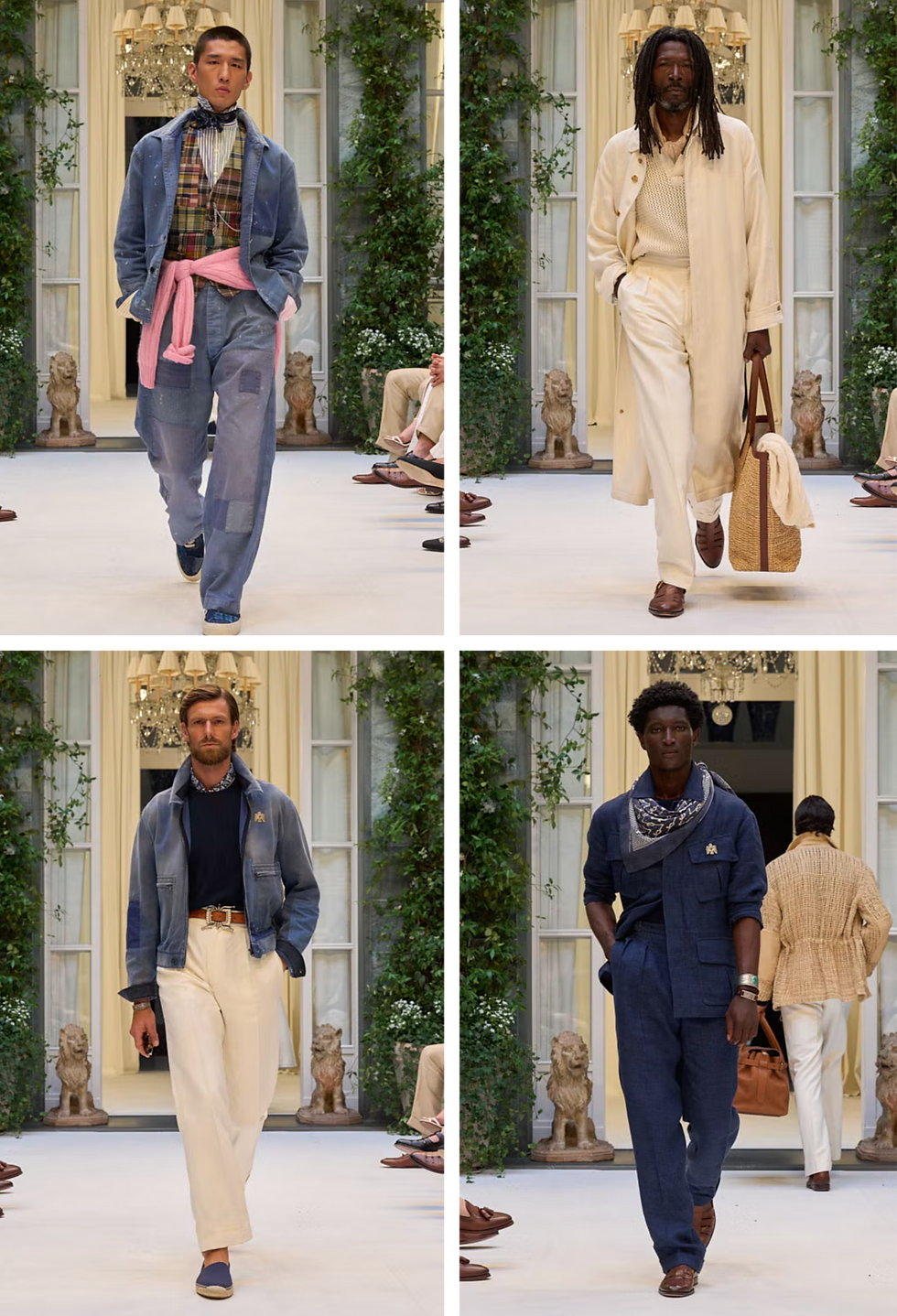
Ralph Lauren’s last two men’s collections out of Milan have been some of the strongest work I have seen from the house in decades. I say that as someone who has lived inside that brand. These collections were assured, elevated, and deeply rooted in everything that makes Ralph Lauren what it is. The brand reached $7.1 billion in revenue for the fiscal year ending March 2025 - one of the very few brands outside the all ultra-luxury tier to grow while the broader market contracted. And yet, somewhere in the comments sections of the internet, I have been seeing a take that genuinely stopped me cold... that Ralph Lauren is copying Aimé Leon Dore.
I had to set the record straight.
Let’s Talk About the Lineage
Aimé Leon Dore is a genuinely great brand. Teddy Santis is a creative visionary who built something real. I have tremendous respect for what he has accomplished. But let’s be clear about where the inspiration flows.
Santis said it himself in a 2017 interview with SSENSE:
“For me, Ralph Lauren is the perfect thing. I discovered Ralph when I was 15 and I’m 30 now, feeling the exact same way. If anything, I feel more connected because they keep educating you and showing you things that put you outside the comfort level of a polo or an oxford.” — Teddy Santis, SSENSE, 2017
He has also said directly that Ralph Lauren was his starting point - that he saw a void adjacent to what Ralph had built and set out to speak to it. That is not a designer copying his contemporaries. That is a designer standing on the shoulders of a giant and acknowledging it openly.
ALD built something meaningful in that space, and the menswear world is richer for it. But the idea that Ralph Lauren is now drawing from Aimé Leon Dore’s archive inverts the lineage entirely. If anything, ALD went into the Ralph Lauren archives and found the foundation of what it wanted to become. That’s not a criticism, it’s a compliment to how deep and enduring the source material is.
Consistency Is a Culture, Not Just a Concept
What most people miss when they talk about Ralph Lauren’s longevity is that the consistency on the outside is a direct reflection of the culture on the inside. This brand didn’t stay the course by accident. It stayed the course because Ralph built a team of people who understood his vision completely and stayed to execute it - for decades.
Buffy Birrittella joined the company in 1971 and spent 50 years as his EVP, Senior Adviser, and Senior Creative Director of Womenswear before retiring in 2021. Ralph Lauren said of her: she “understood my vision from the very beginning.” John Wrazej has been EVP and Senior Creative Director of Men’s - overseeing Purple Label, Polo, RLX, and more since 1988. He was in the room for the Milan Fall 2026 show and was specifically recognized by leadership for what that collection represented. Karen Brown joined in 2006, rose through design roles across nearly two decades, and now serves as Senior Brand Creative Director of Women’s Polo, reporting directly to Ralph Lauren. And David Lauren, his son, has been a board member and EVP central to the brand’s evolution for years.
These are not interchangeable executives. These are people who were immersed in the vision long enough to become carriers of it. That depth of institutional knowledge, and Ralph’s ability to train, retain, and trust it is as much a part of the brand’s success as any collection he has ever produced.
Add to that the architecture of the collections themselves. The layering of Purple Label and Polo isn’t just a tiering strategy, it’s a masterclass in how to speak to multiple customers at different price points without ever diluting the world. Each label is distinct in its expression and consistent in its DNA. That is not easy to execute. It requires a creative merchant’s mind, and Ralph Lauren is the original master.

What No Other Brand Has Done at This Scale
Here’s what makes the current Ralph Lauren moment so remarkable to watch: this is not a relaunch. There is no new creative director, no pivot, no repositioning. The brand has not chased a trend or hired someone to make it feel younger. It simply stayed the course - through the years when it was considered dated, through the cycles when the industry moved on - and the industry came back.
As of 2025, Ralph Lauren ranked second only to Gucci as the most desirable luxury brand among consumers under 35, according to research firm Kantar. A brand that has existed for nearly six decades, beloved by the generation that grew up with it and now being discovered all over again by their children. That does not happen by accident. It happens because the foundation was built correctly the first time.
For Fall 2026, Ralph Lauren returned to a full runway show in Milan for the first time in over two decades. And he did it at the Palazzo Ralph Lauren, the brand’s own headquarters on Via San Barnaba. Not a rented event space. Not a borrowed room for an evening. His brand’s home in that city. That is not a statement of reinvention. That is a statement of arrival, made from a position of total confidence.
What The Ralph Lauren Brand Strategy Teaches Us
The Ralph Lauren brand strategy isn't a document. It isn't a mood board. It's a decision made every single day to stay the course.
The temptation in brand building is to chase relevance. To respond to what is happening around you. To reposition when the market shifts. Ralph Lauren never did that. And the brands that tried to out-Ralph Ralph - borrowing the codes, layering on the lifestyle imagery, hiring the right casting agents - are not the ones people are writing about today.
Clarity of vision. Relentless discipline. The patience to compound decisions over decades. That is not a marketing strategy. That is a character trait - and it is rare.
I talk with fashion brand leaders every day who are trying to figure out who they are at scale, what to build in-house, what to protect, and where their own version of that kind of consistency lives. The Ralph Lauren story is not just inspiring. It is instructive. The brands that endure are the ones that know exactly what they stand for and never negotiate on it - not for a trend cycle, not for a generation shift, and not for the flattery of imitation.
If you are trying to build that kind of brand clarity into your own business, whether that’s structure, merchandising strategy, or the team around you - that is exactly the work we do at Framework Fashion.
Comments